

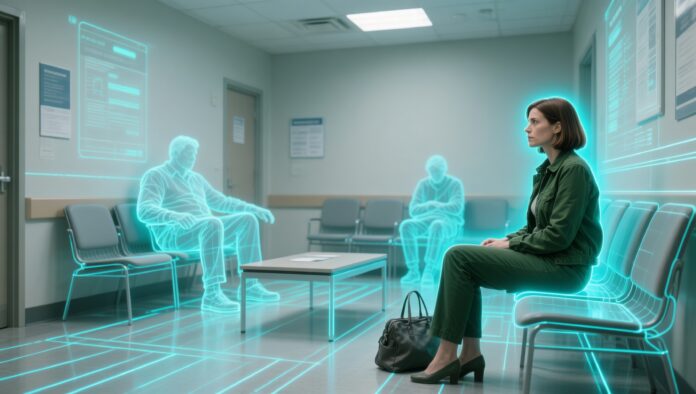
You walk in, look for a seat, and before you are fully settled, the room is already sorted.
Not consciously. Not in words. But the scan has happened anyway. Who looks composed. Who looks uneasy. Who seems like they belong anywhere. Who seems to be apologizing for taking up space. The strange part is how quickly it happens. You do not decide to start judging. Your mind is already mid-assessment before your body has even finished sitting down. Research on first impressions suggests that people form trait judgments from faces with extraordinary speed — sometimes after just 100 milliseconds.
Most people dislike admitting this, because it sounds unkind.
But the deeper truth is less moral and more biological. Human beings are exquisitely tuned to social position, relative confidence, and interpersonal threat. We do not merely notice other people. We locate them. We estimate how much power they have, how safe they are to approach, how likely they are to dominate, withdraw, welcome, ignore, or compete. A waiting room may look like a neutral modern space, but to an old nervous system it is still a room full of strangers, and strangers are never processed as neutral for very long. Reviews of status perception suggest that humans rapidly identify social status from a wide range of cues, from physical presence to culturally learned markers of rank.

That is why the waiting room matters more than it seems.
On paper, everyone there is equal. No one officially outranks anyone else. But the brain does not wait for official structure. It reads signals. The person sitting expansively with slow, unhurried movements. The one whose eyes move across the room instead of collapsing into a phone. The one whose body seems at ease in public view. These are not trivial details. Status perception research shows that people are often able to judge relative status above chance and that they rely on behavioral and appearance cues when doing it.
What feels like a private impression is often built from public information.
Posture matters. Expression matters. Gaze matters. The overall coherence of how someone occupies their body matters. Research on physical appearance and first impressions suggests that observers do not extract only vague aesthetics from a person’s presentation; they pick up socially meaningful information from posture, facial expression, and other visible cues. Other work on body perception suggests that social judgments based on bodies are organized in part around dimensions such as trustworthiness and dominance. In other words, when you think you are “just getting a feeling” about someone in the room, that feeling is often structured around the very cues human beings use again and again to size one another up.
And the signal does not move in one direction.
While you are reading the room, the room is reading you. Your posture, your stillness or restlessness, whether you spread out or fold inward, whether your attention meets the environment or retreats from it — all of it becomes part of other people’s rapid assessment of where you seem to stand. Nonverbal social cues are especially powerful because they convey emotional, motivational, and trait information quickly and often outside conscious awareness. That means people influence the interpersonal atmosphere of a room long before they say anything worth quoting.
This is one reason social situations can feel tiring even when nothing “happened.”
A waiting room is rarely just a place where time passes. It is a small field of continuous ranking, comparison, prediction, and adjustment. You notice who seems comfortable. You notice whether you feel bigger or smaller beside them. You notice, without wanting to, whether your own body changes in response. Social hierarchy research suggests that status information affects attention, memory, and interaction in ways that run deeper than people usually realize. We are not only observing the room. We are calibrating ourselves inside it.
Still, speed should not be confused with certainty.
The first read is fast, but it is not infallible. What looks like confidence may be practiced armor. What looks like low status may be fatigue, illness, grief, or simple introversion. What feels like a trustworthy presence may be familiarity rather than truth. Automatic judgments are useful because they are efficient, not because they are perfect. That is the distinction that matters. Awareness does not stop the scan from happening, but it changes what you do with the result.
So no, you are probably not going to stop judging everyone in a waiting room.
That is not really the task.
The task is subtler than that: to recognize that your mind is built to read social rank quickly, to understand that other people are reading you just as quickly, and to refuse the oldest mistake in social perception — treating a first impression as the final truth. The scan is automatic. The conclusion is not.
Source reference with link:
- Willis, J., & Todorov, A. (2006). First impressions: Making up your mind after a 100-ms exposure to a face.
- Koski, J. E., Xie, H., & Olson, I. R. (2015). Understanding social hierarchies: The neural and psychological foundations of status perception.
- Schmid Mast, M., & Hall, J. A. (2004). Who Is the Boss and Who Is Not? Accuracy of Judging Status.
- Naumann, L. P., Vazire, S., Rentfrow, P. J., & Gosling, S. D. (2009). Personality judgments based on physical appearance.
- Tzschaschel, E., Brooks, K. R., & Stephen, I. D. (2022). The valence-dominance model applies to body perception.
- Gilboa-Schechtman, E., & Shachar-Lavie, I. (2013). More than a face: a unified theoretical perspective on nonverbal social cue processing in social anxiety.